Bordeaux (Gironde). A velvet carpet, a rounded sofa and a small water fountain, all in an atmosphere mixing the 1960s and 1990s. No, you are not in the interior of a design lover, but in the brand new welcome of the Museum of Decorative Arts and Design (MADD) in Bordeaux. “Before, we had a very small reception area, the groups waited outside, it was a nightmare for all the teams, recalls Étienne Tornier, deputy director of the museum. One of the major challenges of the project was therefore to create a real reception area to streamline circulation. » The museum then enlisted the services of the Antoine Dufour Architectes agency to design this new steel structure, but also to address a second issue: the creation of a pavilion which would harmoniously connect the two historic wings, namely the Hôtel de Lalande – which houses the decorative arts collections – and the former municipal prison, converted into a temporary exhibition space in 2016. Here again, the choice of an architecture combining glass and steel prevailed. Rather than going out into the courtyard to continue their journey, the visitor now takes this very bright connecting space, open to the outside thanks to a large bay window. “The idea was to have a multipurpose space, a place to breathe between the Decorative Arts and Design sections”explains architect Aymeric Antoine.
Renovated exterior of the Madd in Bordeaux with the glass pavilion in the background which connects the two historic wings: the Hôtel de Lalande houses the decorative arts collections and the former municipal prison converted into an exhibition space.
© Lysiane Gauthier / City of Bordeaux
Reorganized spaces
“Over the centuries, the museum had been transformed. The corridors have multiplied, the volumes have been lowered, numerous developments have modified the whole. Little by little, the empty spaces on the site gave way to full ones,” he observes. After three years of work, the spaces have become much more readable. Partitions were removed, ceilings raised, floors removed. By regaining its opening to the sky, the old stable courtyard brings in more light. And when natural light is not enough, artificial lighting subtly takes over.
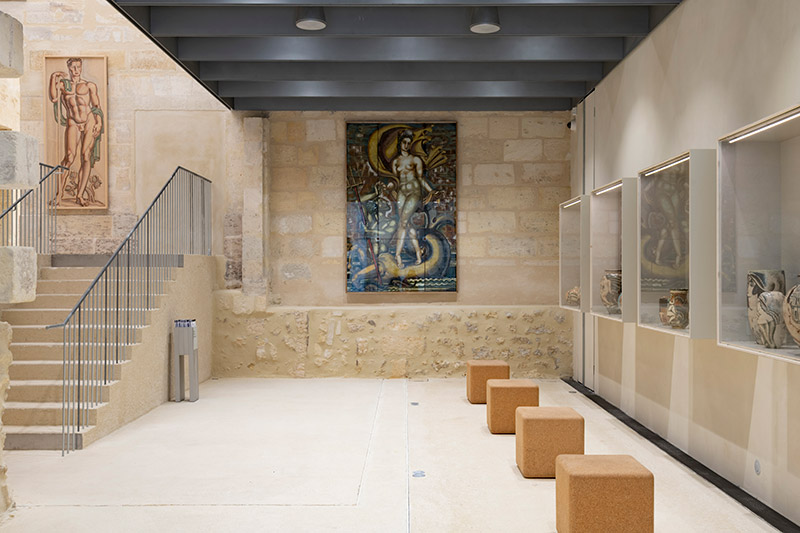
From the entrance, a strong scenographic gesture stands out: a monumental shelf presents nearly eighty vases, highlighted by backlighting. Iconic pieces from big names in design, such as Andrea Branzi (1938-2023) or Gaetano Pesce (1939-2024), interact with ancient and contemporary vases. This same prolific dialogue guides the creation of a “ gallery of know-how »on the site of former rooms dedicated to conferences and educational workshops, merged into a single space. “It’s a presentation that we plan to renew approximately every eighteen months, and which will each time be devoted to a technique, a gesture, a material that we wish to approach in a transchronological way,” explains Étienne Tornier. For this first, it is ceramics that sets the tone.
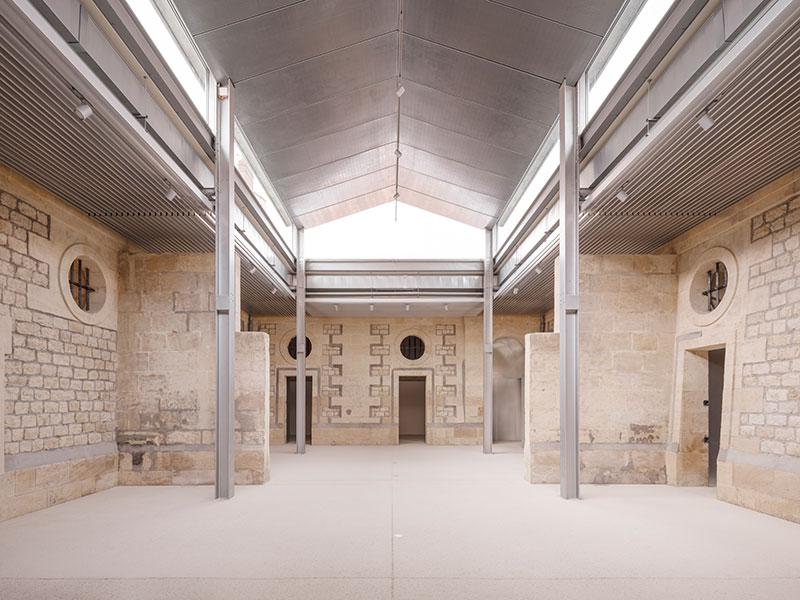
The interior of the renovated Madd: the prison.
© Célia Uhalde
The least remodeled space remains that of the old prison. Less reworked, but not unchanged. Air renewal systems, glass roof replacement, humidity control, etc., all these interventions have considerably improved the conservation conditions of the works. With this same perspective, the MADD has a graphic arts office, set up in a room at the start of the course which was not previously open to the public. “ In Bordeaux, there was not really a place dedicated to the presentation of drawings. And with two rotations per year, it’s a great opportunity to promote our collections and create bridges between them”rejoices Olivier Hurstel, head of old collections at MADD. The museum is taking advantage of this new space to remove part of its Jacques Sargos collection from reserves, which brings together more than 130 old drawings linked to the decorative arts, architecture and ornament.
However, its metamorphosis is not complete. The budget of 14 million euros – shared between the City (47%), the State (26%), the Region (7%), Europe (6%) and sponsorship (14%) – does not include the second part of the project, less ambitious but just as necessary: the renovation of the Hôtel de Lalande. The 18th century mansion will not reopen before the end of 2027, while its ceilings, woodwork, paintings and stucco are redone. The enclosure and cover have already been restored, with the aim of reducing energy consumption by 40%. Ultimately, the route will be completely renewed on three levels: around 3,000 works will highlight new themes, will single out certain techniques and know-how, supported by a redesigned scenography and mediation devices. As for the important restoration work carried out behind the scenes on the collections, starting with those of old weapons and miniatures, it will make it possible to present unpublished pieces which have until now been lying dormant in reserve. Patience, therefore.