Sigena (Spain). The decision handed down by the Huesca court now constitutes the central framework of the case of the wall paintings of the monastery of Sigena, in Aragon, detached from the walls in 1936, at the start of the Spanish civil war, after the fire of the monastery, then transferred to Catalonia for conservation. By an order of April 10, 2026, the judge set a maximum deadline of fifty-six weeks to organize the restitution of the works kept at the National Art Museum of Catalonia (MNAC), in Barcelona. This injunction does not call into question the principle of return, already decided by the Spanish courts, but strictly regulates the methods of execution. On April 22, the MNAC filed an appeal for reform, contesting not the restitution itself, but its technical conditions and its timetable.
This temporality aims to avoid any procedural stalemate. But it introduces a strong constraint on the scientific and technical teams responsible for the operation. It is on this point that the challenge from the MNAC crystallizes, which considers that the court underestimated the complexity of the intervention.
Sigena’s murals at the National Art Museum of Catalonia, Barcelona.
In its appeal, the museum emphasizes that the decision is based on an insufficiently integrated reading of conservation constraints: “The question is not only to return the works, but to do so without compromising their integrity. » The MNAC considers that feasibility was accepted without taking into account all the expertise.
Filed on April 22, 2026, the appeal does not call into question the obligation to return the Sigena frescoes, but requests a review of the terms set by the order of April 10. The MNAC cites the failure to take into account certain technical expertise, a reading deemed reductive of the initial judgment, and above all the absence of a commission of independent experts.
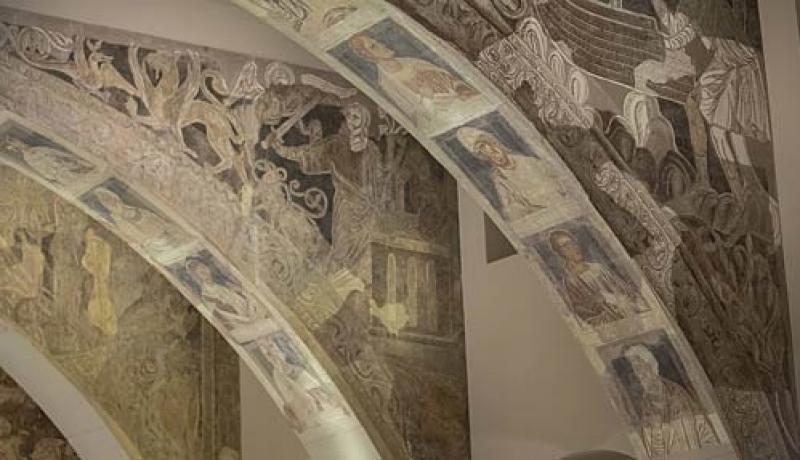
Sigena’s murals in their current state, presented in the last room dedicated to Romanesque art, National Art Museum of Catalonia, Barcelona.
© MNAC
The museum emphasizes the uncertainties of the judicial calendar. The fifty-six week period would not, according to him, be based on a complete evaluation of the stages: diagnosis, dismantling, transport and reinstallation. It therefore calls for reinforced scientific supervision and technical cooperation between the parties.
For Carme Ramells, curator-restorer at MNAC, the question cannot be reduced to a simple alternative. “Viability depends on risk, she explains. And the risk depends on the vulnerability of the paints and the conditions of intervention. » It describes extremely fragile works, made up of very thin pictorial layers and already altered by their history, notably the fire of 1936. Any handling, cutting, transport or reassembly involves risks of cracking or loss of material. She also emphasizes the uncertainty of the resettlement location in Sigena. “ Without knowing precisely the final support, it is impossible to correctly define the cutting method,” she emphasizes.