New York,
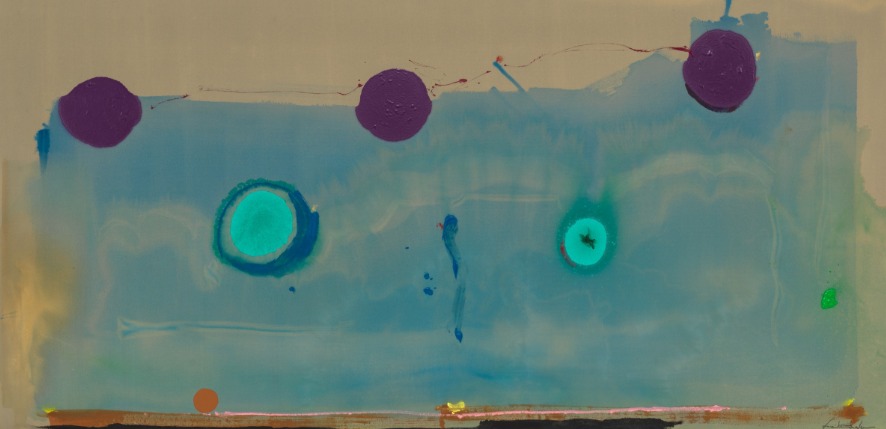
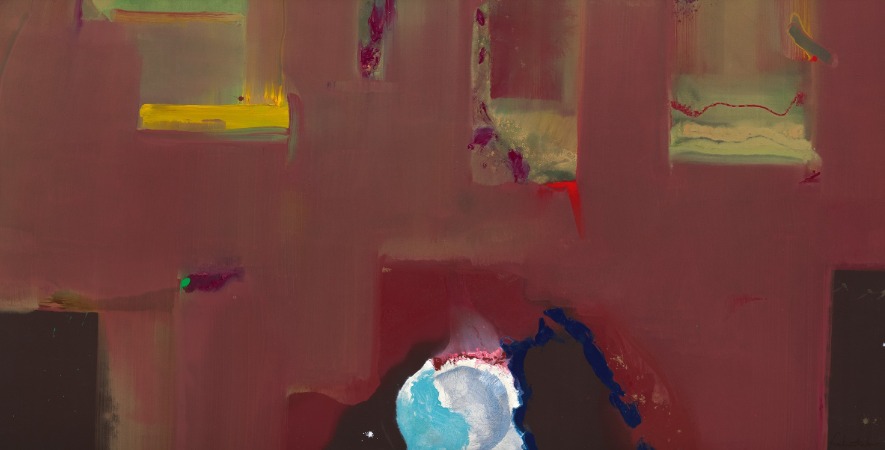
Twenty large-format works and more than three decades of painting. Gagosian presents “The Moment and the Distance” in New York, an exhibition that reviews the evolution of Helen Frankenthaler’s career from 1960 to 1992; The works gathered, in chronological order, have in common their monumental scale, their sensual coloring and their compositions that are difficult to label, but when brought together they offer new perspectives on the continuous search for reinventions in the practice of the American artist.
The title of the exhibition is taken from an incisive 1975 essay by Barbara Guest, poet and friend of Frankenthaler, who wrote that Frankenthaler had given us an astonishing combination of freedom and restraint, extravagance and discipline, suggestion and definition. In his production, he noted, the moment becomes distance.
The chosen canvases come to embody the exploratory and lyrical approach from which he approached abstraction and benefit from that expansive scale that underlines the visual impact of his bright palette and his gestures.
One of the earliest compositions on the tour is Provincetown I (1961), created with diluted oil paint and applied directly on untreated canvas, which seduces with its contrasts between rigorous line and expressive color, delimited and free forms. At the end of that decade and during the 1970s, Frankenthaler embarked on a transition from oil to acrylic paint, and began composing with large flat spots of color; on that path, Mornings (1971) is distinguished by its fluid descents of yellow, beige and white tones, interrupted by linear filaments drawn with a black marker, an instrument that he also used in thanksgiving (1972), to organize biomorphic configurations in precarious balance.
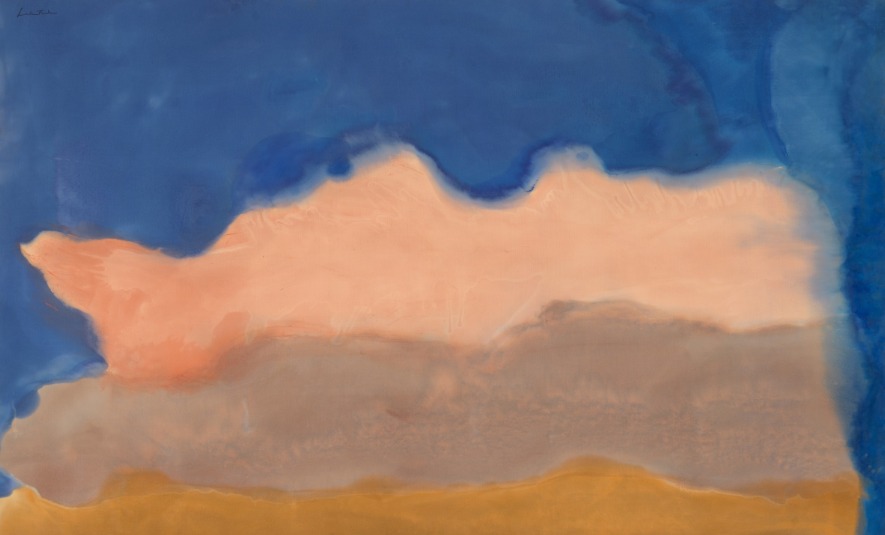
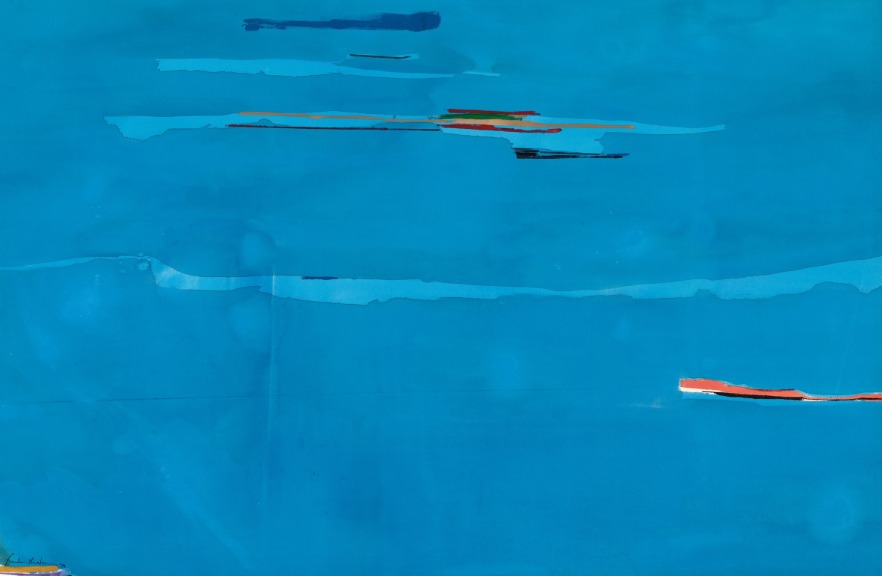
Throughout his career, Frankenthaler maintained a constant dialogue with the history of art. This exhibition comes Auguste (1977), for which he was inspired by Auguste Renoir, reinterpreting the fleshy palette of the impressionist painter in a field of loose, rectilinear brushstrokes. Allusions to the landscape are also a constant in his work: in Ocean Drive West #1 (1974), whose title refers to the address of his seaside studio at Shippan Point in Connecticut, spread striated bands across a vibrant blue canvas that suggest currents; Meanwhile, the broad horizontal composition of Shippan October (1981) evokes the seascape of Long Island Sound in the autumn light.
Frankenthaler once described his canvases as “internal amorphous worlds or depths that explode on the surface and into perspective.” The pigment floods A Green Thought in a Green Shade (1981), dotted with opaque elements in contrasting colors, while in Janus (1990) reflected accumulations of overlapping gray tones confront each other in the center of the image, framed by passages of intense chromaticism and vaporous textures.
Together, these paintings demonstrate Frankenthaler’s continued introduction of new pictorial techniques into his work, as well as his firm commitment to the language of abstraction, which he never abandoned as his career progressed.
Ambitious since her childhood, as a child the artist decided to draw a line on the ground with chalk from her family’s apartment on the Upper East Side of Manhattan to the Metropolitan Museum and, in 1950, when she was only twenty-one years old, she was commissioned to organize the graduation exhibition for the students of Bennington, the Liberal College of Fine Arts in Vermont, where she herself had trained and where she received classes from Paul Feeley, also an artist, who shared a generation with the abstract expressionists.
He dared to invite Clement Greenberg, then a powerful critic of The Nation and Pollock’s defender, to come, and he did (they say under the promise of a copious aperitif). Despite how much separated them, they began a relationship that lasted nearly five years and that would have to do with Frankenthaler attending the openings of the New York School at the Betty Parsons Gallery; Pollock’s rejection of easel painting would encourage her to be more daring in her methods.
That was the beginning of a career that would make her one of the main figures of American abstract expressionism, under the continuous mantra of the absence of rules, of soak and stain and the incorporation of signs, symbols and scenes that point out without actually revealing. Ambiguity and mystery were, in fact, two of his central searches: he was interested in those compositions that, like certain texts, could provoke different readings in their viewers and that could be part of open processes, a notion that he learned from the aforementioned Pollock.
Frankenthaler soon announced that for her the pictorial experience had been born to illuminate spatial sensations and limits, beyond the desire to be carried away by certain genres: The backbone of the painting, what makes one respond, has very little to do with the subject itself, and rather with the interaction of spaces and the juxtaposition of shapes.
The backbone of the painting, what makes one respond, has very little to do with the subject itself, and rather with the interaction of spaces and the juxtaposition of shapes.
That did not mean that certain environments were not more than inspiring: the summers she spent in the sixties on Cape Cod, with Motherwell, who was her husband for thirteen years, opened new paths for her art. He then knew how to give a place to humor and theoretical imperfections. In Provincetown they were often visited by the sculptor David Smith, with whom Frankenthaler shared that motto of There are no rules that had to affect all disciplines, materials and methods, and even tone: his works could be both celebratory and somber.
If his summers with Motherwell were linked to Cape Cod, those after his divorce would be dedicated to traveling through Europe. Over time he ended up acquiring a house on Long Island and his seascapes from the seventies would lay the foundations for his other environmentally evocative abstractions. At the same time he would carry out paintings with stripes that evoked urban verticality, but above all images that suggested cavities, geological formations, abysses… or birth canals; Once again it will be the public who must grant their vision. When he mastered the stain technique, he chose to pour paint and draw with absolute confidence, attempting to give depth to the plane of the canvas through the play of light.
As he advanced in career and age, it would be vital for Frankenthaler both to maintain his urban contacts and to distance himself from them near the sea, and his interest in very different stages of art history would persist: from the Paleolithic to Monet’s water lilies, passing through Titian, Velázquez and Rembrandt. In them, when asked by another critic, Barbara Rose, she stated that she found light, as well as a tonal universe: translucent veils, transparencies, another management of space.
The spontaneity that was, in essence, the beginning of all his works could evolve pictorially in different directions: either being resolved with small touch-ups and in a single session, or in more worked, dense or scratched surfaces that, regardless of the hours involved, seemed, according to Frankenthaler, that They had just been born.
“Helen Frankenthaler. The moment and the distance”
GAGOSIAN
West 21st Street
New York
From April 30 to July 2, 2026