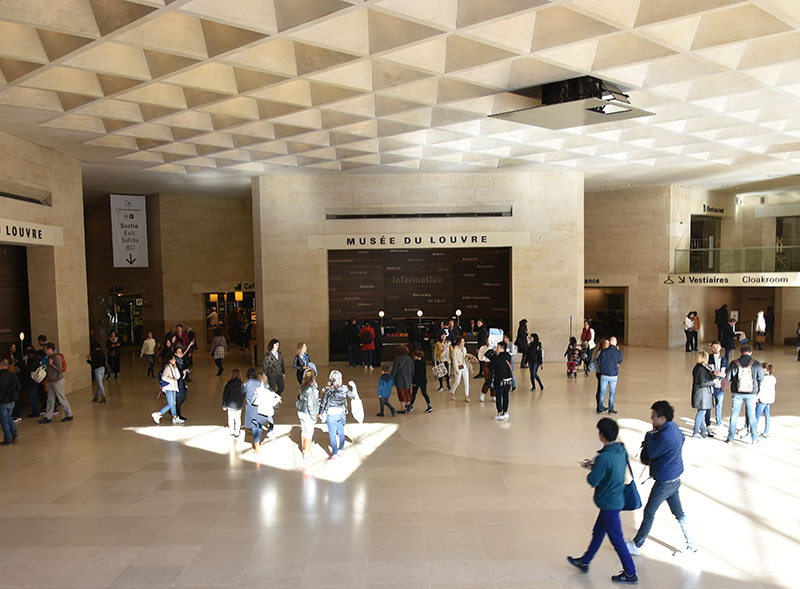
France. In October 2024, the Sud-Culture, SUD-PTT and Solidaires unions opened an unprecedented front in the cultural sector by filing four complaints targeting, in Paris, the Louvre, the Palais de la Porte Dorée, the Bourse de commerce-Pinault Collection, and in Marseille the MuCEM, as well as several service providers, including the host and hostess agencies Marianne International and Pénélope. In September 2025, the same organizations announced two new complaints, against the National Museum of Natural History in Paris and Radio France. On April 1, 2026, finally, complaints were made public against the Maison Gainsbourg and the Gustave-Moreau Museum (Paris). The subject of these complaints: the expansion of outsourcing to new services, such as ticketing and reception, and the suspicion of “illicit loan of labor” and “bargaining”.
Under French law, outsourcing is not illegal in itself, including in a museum. On the other hand, the provision for consideration of labor carried out outside of any other provision of services is unlawful. A public or private cultural establishment can therefore purchase a reception, cloakroom, ticketing or mediation service. The legal risk appears when the service contract no longer corresponds to a truly autonomous activity on the part of the service provider, but becomes the simple guise of the provision of personnel under the de facto authority of the cultural establishment. This is then the terrain of “bargaining”, defined by article L. 8231-1 of the labor code, and of “illicit loan of labor”, referred to in article L. 8241-1.
The link of subordination
It is appropriate to distinguish the service market targeted here and the concession (a bookstore, a restaurant), in which the service provider assumes an operating risk. Ticketing is a special case. The general code of local authorities does allow the collection of access rights to cultural services to be entrusted to a third party, but only by written agreement and after the approval of the public accountant.
The crux of the matter lies in the link of subordination. Since the Société Générale judgment of November 13, 1996, constantly taken up by case law, there is subordination when work is carried out under the authority of an employer who has the power to give orders and directives, to control their execution and to sanction breaches. This definition was again recalled by the criminal chamber on April 5, 2022. The judge never stops at the title of the contract; he looks at who actually commands the work on a daily basis.
This is precisely the red line anticipated by the social charter of the Ministry of Culture of 2015. The charter recalls that relations with service providers are governed by both public procurement and labor law; above all, it lays down a very concrete rule: the agents of the beneficiary entity must refrain from giving direct instructions to the service provider’s employees, and their comments must be sent back through the department responsible for executing the contract. As soon as a museum itself organizes rotations, distributes positions, arbitrates breaks, modifies schedules or directly deals with incidents involving staff, it runs the risk of being accused of a transfer of management power.
The legal analysis of Me Guillaume Roland of the Herald firm, counsel to the Marianne company, goes to the heart of the case law: “The determining criteria are the real autonomy of the service, the existence of a specific technicality or organization of the service provider, the maintenance of the power of direction and control, the absence of integration of employees into the museum service as if they were its own agents”, he explains.
Me Roland recalls in this regard the Sogeti judgment of December 7, 2016, by which the Court of Cassation validated the service for this reason that the service provider retained control over the assignment by mission sheets, the evaluation, the control of working time, absences and the training of its employees, while providing specific technical skills. Same logic in the Park Hyatt case, March 4, 2020: the outsourcing of cleaning was not censored because the service provider provided the products, materials, supervision and administration of staff, without demonstrated subordination to the hotel.
Conversely, sentencing decisions directly illuminate the ridgeline. On August 10, 1993, in the case of hotel maids, the criminal chamber validated the analysis according to which the alleged maintenance contracts masked a simple supply of labor: the hotel decided each day the number of rooms to clean, there was no real manager of the service provider on site, and the employees worked under the sole authority of the hotel.
The museum is not the hierarchical superior
On June 17, 2005, the social chamber again upheld the “illicit loan” because the lending company had not retained any power of control or direction over the employee placed under the authority of another company. In 2013, in the Orange Caraibes case, the criminal chamber approved an appeal court which, after noting that the service provider’s employees received instructions from the client, worked with its equipment and were integrated into its IT service, concluded that Orange Caraibes was their real employer. “In all these cases, the judge does not focus on the content of the contract, but concretely verifies who gives the orders, organizes and controls the execution of the service”, summarizes Me Julie Pleuvret, of the Herald firm.
For museum management, the border is fragile. A museum can define a need, a level of quality, opening hours, specifications, an expected volume of staff and performance indicators. On the other hand, he must not behave like the hierarchical superior of the service provider’s employees. He can control the outcome; he must not organize the services himself. However, on a daily basis, especially for reception, ticketing and mediation missions, the interactions between the museum’s salaried agents and the service provider’s agents are numerous and can sometimes resemble instructions.
On the service providers’ side, it is noted that the labor disputes with their employees that industrial tribunals have had to resolve are not numerous. Service providers, museums and lawyers point out that to date no museum has been prosecuted for “illicit loan of labor”. ” Besides, emphasizes Me Roland, apart from a few hearings of employees by the Central Office for Combating Illegal Work, we have no information from the courts on the complaints from October 2024.”