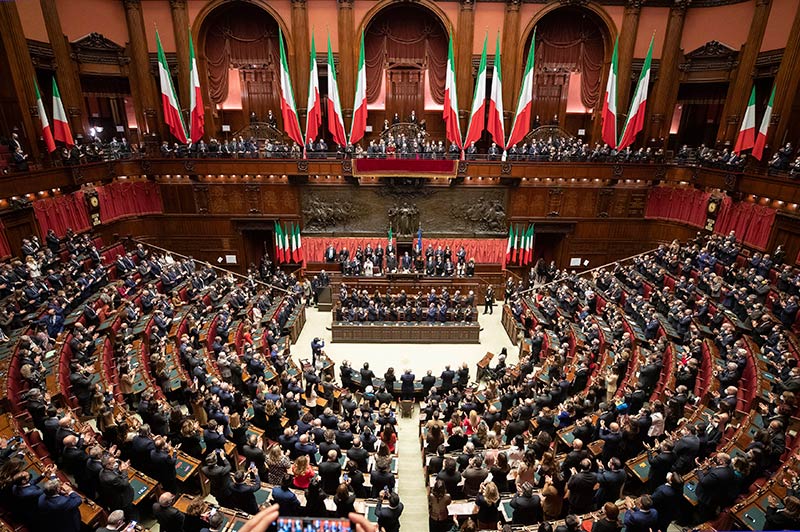
Italy. On March 11, the Italian Senate approved a reform of the Cultural Property Code, a first in almost two decades. Federico Mollicone, the president of the Culture Committee of the Chamber of Deputies at the origin of this initiative, welcomes a historic turning point implementing the principle of horizontal subsidiarity, provided for by the Italian Constitution. Citizens, foundations and private companies will be able to carry out activities of general interest instead of or alongside public administration to actively participate in the management and promotion of heritage. The government assures that this will make it possible to overcome the administrative rigidities which often slow down the development of minor cultural sites.
A Digital Directory and a Subsidiarity Register will be established to draw up a precise inventory of public heritage by promoting partnership with private actors. The Ministry of Culture will be responsible for the first, which constitutes an exhaustive census both on the management method and on the state of buildings or cultural sites. Each owner administration will have the obligation to ensure that this data is updated to identify abandoned or poorly exploited properties. The Subsidiarity Register will, however, be reserved for private actors (individuals or associations) wishing to participate in the indirect management of public goods. Members of this register will be asked to respond to calls for projects and will actively participate in the design of strategic cultural development plans. An annual budget of €500,000 will be allocated this year to set up this system.
The administration is subject to an obligation to respond within 90 days for any loan request. This measure aims to put an end to the bureaucratic delays which have hitherto hampered the organization of exhibitions. “ To promote the market, explains President Federico Mollicone, we are almost quadrupling the value threshold for exports. For foreign artists, the certificate of free movement becomes the rule; it can only be refused if a strong historical link with Italian culture is demonstrated. » The export procedure becomes revocable. An owner can withdraw his request before being refused by the State, thus avoiding the permanent blocking of his work. Article 6 of the reform relating to the “circulation of works” will finally aim to promote museum reserves. The ministry will publish, every two years, an official list of works stored in reserve but available for exhibition elsewhere. Municipalities will be able to request the loan of these works. To do this, they will have to cover all costs and guarantee satisfactory security and exhibition conditions.
A very critical report on the loan of works
Alongside this legislative progress, the Italian museum sector has set up a permanent Observatory on loans of works of art. The first report from this organization was made public on March 19 in Florence and deplores the lack of cohesion in museum policy in this area. This is essentially based on personal relationships between directors or under the pressure of political and diplomatic opportunities, rather than according to a real scientific and economic strategy. The Observatory highlights several critical points such as authorization deadlines for international loans, transport and insurance costs which represent colossal budgets that small museums cannot assume, and finally a “flow imbalance”. Many works are intended for major temporary exhibitions while too few “long term loans” are agreed. However, they would make it possible to revitalize small museums in difficulty. Only 44% of Italian museums have staff dedicated to managing loans which generate on average only 28,000 euros in revenue per year in the peninsula compared to an average of 95,000 euros for foreign establishments.