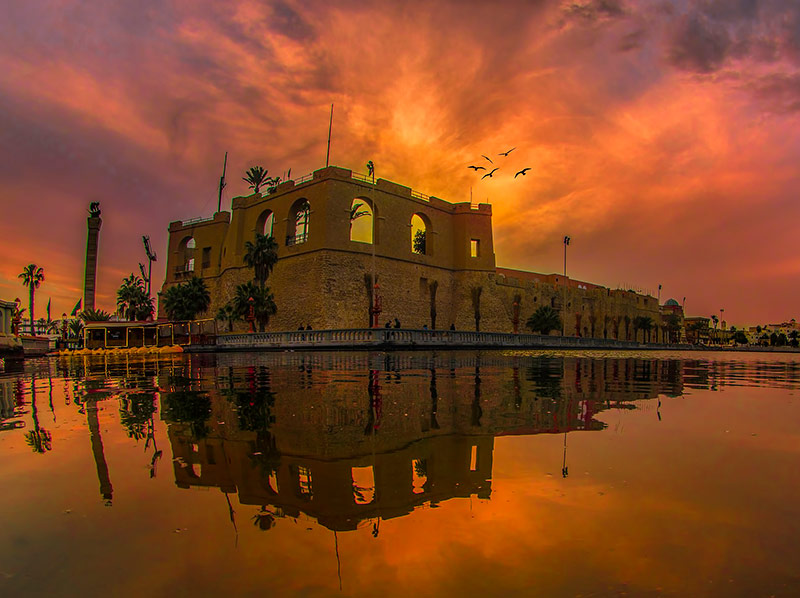
The ramparts of the “Château Rouge” have been lit again after years of silence. On December 12, 2025, Tripoli vibrated for the reopening of the National Museum of Libya, housed in the “Red Castle” (As-Sarya al-Hamra) complex. Closed since 2011, after the fall of Muammar Gaddafi (1942-2011), the museum reopens fourteen years later. The inauguration gave rise to a large fireworks display and a show combining music, acrobats and light shows.
Built in the 1980s, the National Museum of Libya is one of the largest museums in North Africa. It offers approximately 10,000 m2 of exhibition rooms. Its four floors retrace the millennial history of Libya: we discover prehistoric remains, Phoenician and Punic amphorae, Greco-Roman mosaics and statues, as well as Byzantine and Islamic works. The collection includes, among other things, cave paintings comparable to those of Lascaux, tablets in the Punic alphabet, mosaics from Lépis Magna and Sabratha and mummies over 5,000 years old from the archaeological sites of Uan Muhuggiag (deep south) and Jaghbub (Egyptian border). In addition to its Roman and Greek heritage, the museum houses Islamic and Ottoman treasures, reflecting the multiple occupations of the Libyan Mediterranean coast.
Despite the 2011 revolution and the insurrection that toppled Muammar Gaddafi, the museum suffered surprisingly little. The curators had anticipated the unrest: they spent two months inventorying and storing the most precious pieces in secret caches. When rebels, part of the anti-Gaddafi coalition, entered the museum in August 2011, they destroyed only symbolic objects belonging to the dictator. Only a few items of low value (a coat, a rifle from the War of Liberation) and Muammar Gaddafi’s famous blue Volkswagen Beetle were damaged or stolen. However, there were a few thefts that Libya was able to recover: at the end of 2025, 21 objects were repatriated (parts sent to France, Switzerland, United States). Negotiations are underway with Spain and Austria.
Since the fall of the regime, Libya has been plunged into a chaotic situation. In 2014, a civil war broke out between two rival governments. To the west, in and around Tripoli, the General National Congress is supported by militias close to Misrata with the support of Qatar and Turkey. In the east, a parallel authority sits in Tobruk with the support of the Libyan National Army (LNA) of Marshal Khalifa Belqasim Haftar. The authority is politically supported by the Eastern Parliament and by Egypt, Saudi Arabia and the Emirates. They control Cyrenaica and much of the south. This second political pole was not internationally recognized after 2016, but asserted itself militarily.
Since 2020, pacification efforts have led to a ceasefire and the formation of the Government of National Unity (GNU), based in Tripoli since March 15, 2021. This government has been recognized by the United Nations. However, in 2025 institutions remain fragile. Prime Minister Abdel Hamid Dbeibah, who came to power through a UN process, has never been elected by universal suffrage. In the meantime, tensions persist: clashes between militias loyal or hostile to the government broke out in Tripoli in the spring of 2025.
It is in this context of relative and fragile stabilization that the reopening of the museum takes on its full political meaning. Since March 2023, the GNU has financed the renovation of the museum. The objective is twofold: to reopen one of the richest museums in the Mediterranean to the public and to send a signal of normalization in a country shaken by political divisions.
Mustafa Turjman, director of Archaeological Research at the Antiquities Department of Libya, insists on the role of unification as a vector of unity: the (rare) Western visitors can admire the heritage of Eastern Cyrenaica, and the inhabitants of the East see pieces from the West in Tripoli – which, according to him, helps to “reunify the two regions”. The exhibition reserved its first weeks for Libyan schoolchildren in order to catch up on the “propaganda years” of the Gaddafi era. Commentators note that the event is a diplomatic (number of embassies reopen) and economic (oil investments return) catalyst. But the eastern authorities take a mixed view of this rehabilitation project because this reopening strengthens the position of the Tripoli government on the international scene.