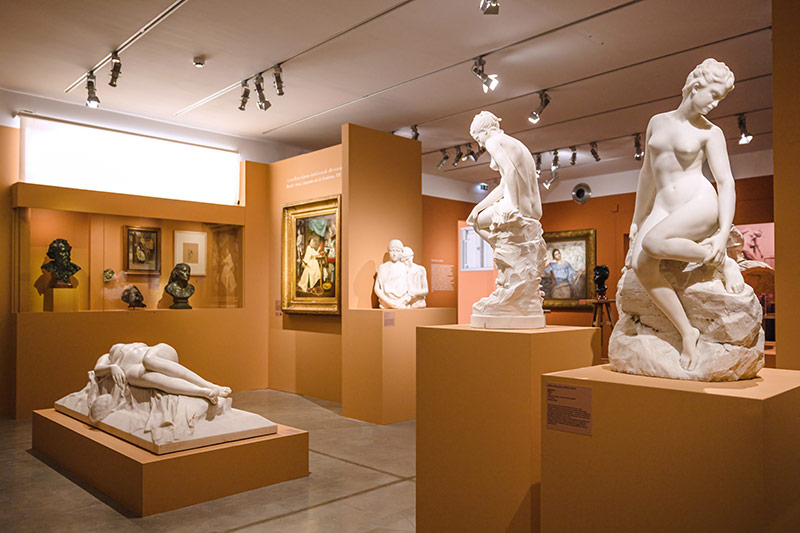
Nogent-sur-Seine (Aube). The art historian Anne Rivière, specialist in Camille Claudel, was interested in 19th century female sculptors and published the Dictionary of female sculptors in France (Mare & Martin, 2017). A subject that could only concern Céline Bertran, director of the Camille Claudel Museum, but also Hélène Jagot, director of the museums and the Château de Tours, as well as Sophie Kervran, director of the Pont-Aven Museum, who have works by sculptors of Claudel’s generation in their collections. Together, they organized an exhibition of around 90 works which, after the Camille Claudel Museum, will continue its journey to Tours then to Pont-Aven. Approaching their subject from different angles, the scientific curators, Anne Rivière and Pauline Fleury, tell visitors what the existence of 23 French and foreign women artists who passed through Paris was like, by showing their work but also by discussing their personal lives. The rich mediation and the voluminous catalog give a place to each individuality as much as to the artistic milieu of the time.
If they clearly state that everything was more difficult at the time for women artists than for their male colleagues, the curators put an end to the miserabilism that has long accompanied gender studies. For a simple reason: most of these women came either from artistic families or, like Camille Claudel, from an open-minded bourgeoisie even if the parents could express fears for the future of their child. The reception of their works was often friendly from critics, who could see them at the Salon, and from male artists. The misogynistic assertions of the time which can sometimes be highlighted should not mask the integration of most of these creators into the artistic environment and social life of the time.
The notion of a necessarily misunderstood feminine genius that the public retains in particular from the fate of Camille Claudel is also undermined. The sculptors were not necessarily part of the avant-garde: their works belonged to the entire range of trends of their time, from academicism to symbolism. And, the last preconceived idea, the exhibition underlines that the sorority often highlighted was no more systematic than the fraternity of male artists among themselves. Thus, Camille Claudel, dominant personality of a workshop bringing together several sculptors on rue Notre-Dame-des-Champs, was sometimes unfair towards her colleagues. Along the way, talented women are revealed who were once invisible, as she was also, by 20th century France and who deserve to be rediscovered.