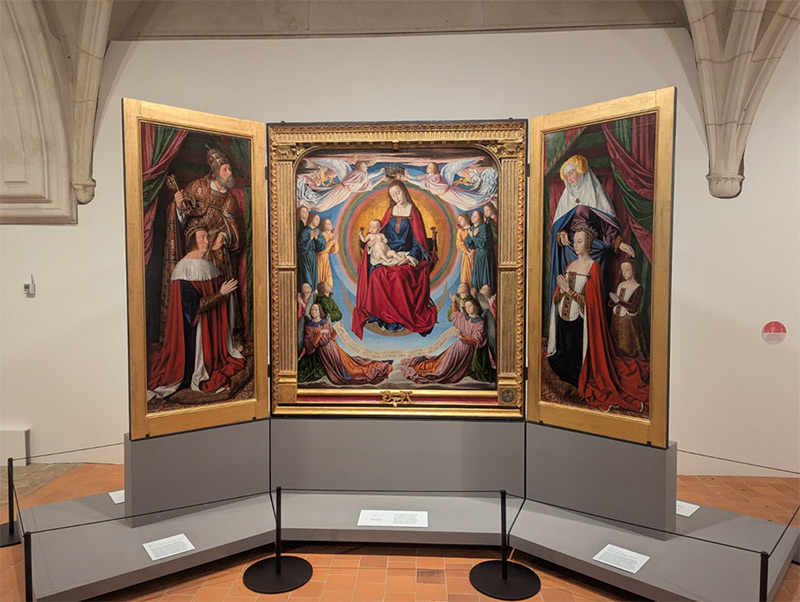
Bourg-en-Bresse (Ain). It usually sits in the cathedral of Moulins (Allier), from which it left the time to unveil its restoration at the Louvre, in 2025-2026. But why this detour to the royal monastery of Brou? At first glance, the presence of Triptych of Moulins in Bourg-en-Bresse surprises. Certainly Jean Hey, the mysterious “Master of Moulins”, also painted the portrait of Marguerite of Austria (1480-1530), the founder of the monastery. We can also compare the latter to Anne de Beaujeu (1461-1522), co-sponsor of the triptych, who raised the young Marguerite at the French court. Some tenuous links therefore, but which are skillfully exploited here to place the work in the artistic milieu of its time. The triptych resonates with a few sculptures and around ten paintings, some by Jean Hey, others by contemporaries who take up the same themes, share the same influences, gravitate within the same patronage networks. Two delicate Virgin and Child by Jean Hey, painted between 1490 and 1500, sit alongside, for example, a Virgin in prayer before the Childundoubtedly due to a Flemish painter active in Bourbonnais.
A larger corpus
This selection renews the way we look at the work, without duplicating the presentation at the Louvre which had remained summary and discreet. In Paris, the triptych occupied a single room in an arrangement more focused on the work itself than on the artistic environment that saw it born. The overlaps between the two are rare: apart from the triptych, only two panels on wood presented at the Louvre have joined the Brou picture rails. In Bourg-en-Bresse, the added value also lies in the bringing together of a larger corpus of works by Jean Hey, around twenty of which are known to us today. Among them is his Ecce Homo (1494), on loan from the Royal Museums of Fine Arts of Belgium, a crucial work for the identification of the artist since it is his only signed painting.
In light of this corpus, the Triptych of Moulins is illuminated from several angles: that of its artist, its sponsors and its artistic context. “This triptych has long been forgotten, it is a work which was rediscovered in the 19the century by local scholars, then by Prosper Mérimée [qui fut inspecteur des monuments historiques], but she traveled very little in realityrecalls curator Magali Briat-Philippe, responsible for heritage at the Brou monastery and curator of the exhibition. Its aura is linked both to its rediscovery, to its extraordinary artistic quality, and to the mystery which surrounded its author since for a very long time we spoke of the “master of Moulins” without knowing who it was. »
Under the vaulted ceilings of the monastery, the imposing triptych – which extends its panels over nearly three meters – can be appreciated with the necessary distance: the Virgin in glory, the sponsors kneeling at her sides and, on the exterior shutters, the grayness. A nice stopover in Bressan country, before the triptych returns to Moulins.