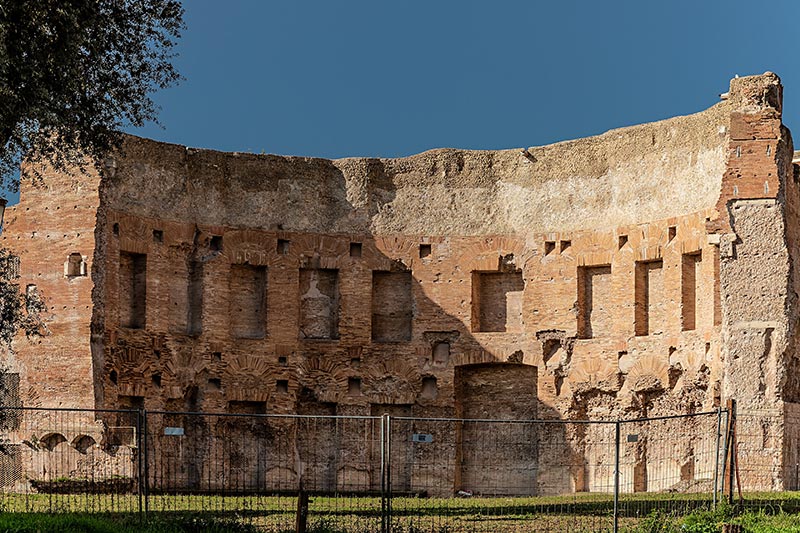
Rome. A new museum opened in September in Rome. The archaeological one of the Baths of Trajan. Its remains stand at the top of Colle Oppio, overlooking the Colosseum. Inaugurated in 109 AD by the emperor who gave them his name, these baths constitute the very first model of the “great imperial baths” of Rome. We owe their design to Apollodorus of Damascus, the most famous architect of his time, who built a vast complex which originally extended over more than 60,000 m². Work during antiquity integrated several older structures, including some basements and galleries dependent on the legendary Domus Aurea of Nero.
A new excavation campaign launched
Some of them were unearthed in the early 1990s and were the subject of a new campaign of archaeological excavations and restoration, financed by the European recovery plan. Among the centerpieces of the new museum is a fresco of approximately 10 m² representing an unidentified Roman city (The dipinta city) (see ill.), certainly an ideal city and above all a large mosaic with still vivid hues, Musa and filosofodepicting characters and architectural elements with striking realism. “It is the largest fresco and mosaic from the Roman era ever discovered,” welcomed Roberto Gualtieri the mayor of Rome “by saluting marvelous works that are truly unique in the world, both in their artistic beauty and in their historical and documentary importance. »
Detail of the large mosaic of an unidentified Roman city, Archaeological Museum of the Baths of Trajan, Rome.
© Sovrintendenza Capitolina
A justified emphasis according to Marina Marcelli of the Special Superintendence of Rome responsible for protecting, conserving and promoting the archaeological, artistic and architectural heritage of the Eternal City. “The Painted City fresco was discovered between 1997 and 1999, but it is now fully visible,” she explains. Dated from the 1st century AD – between the reigns of Nero and the Flavians – it represents a mysterious fortified Roman city, surrounded by walls and defensive towers. The artist depicted with striking realism and refined perspective a theater, a temple, a portico and various residential areas. “The monumental mosaic a few steps away is certainly one of the largest parietal mosaics in the world, continues Marina Marcelli. The excavations revealed a section of wall preserved almost five meters high, in a remarkable condition which allows us to appreciate the work in all its original volume. » What the artist has composed on this wall is a scaenae frons – that is to say a trompe-l’oeil restitution of these monumental architectural facades which served as a fixed backdrop in Roman theaters. Structured on two distinct levels, this feigned architecture is animated by niches and porticos where sculpted statues as well as strikingly realistic human figures take place. “Recent work has revealed an unprecedented lower register: a panel showing a port city lined with maritime villas, surmounting remains of marble veneers and a central niche more than two meters high. It is estimated that the total height of this decorated wall reached nearly 12 meters at the time. »
The museum tour also includes an exedra – a semi-circular building – which will be used for artistic and cultural events. The site will accommodate groups limited to 15 people, to preserve the state of conservation of the works, on Fridays, Saturdays and Sundays during the month of October. The town hall is starting to think about wider opening arrangements.