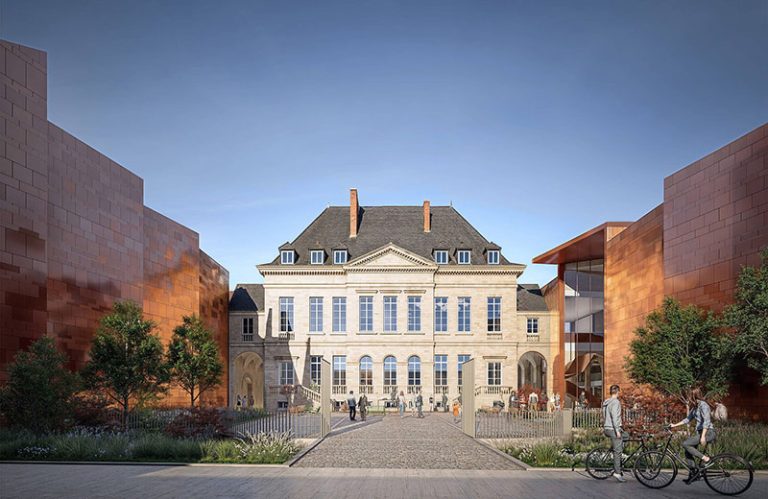
Box office success, the musical The Sound of Music (The Sound of Music) which tells the story of an Austrian family fleeing Austria after the Anschluss was not unanimously received in Austria when it was released in 1965. The Nazi period was still too recent for the inhabitants of Salzburg to support the parade of American actors decorated with swastikas. Today, the seasonal museum Sound of Musicthe new site of the Salzburg Museum, looks back at the true history of the von Trapp family.
Housed in three historic buildings on the Hellbrunn Palace grounds, the collection contains 450 objects and documents, including original costumes, film posters and super 8 videos from filming. The work to transform the premises into exhibition spaces cost more than 4.5 million euros, obtained through public funding, to which is added 1.8 million euros for the development of the route and the rights linked to the film.
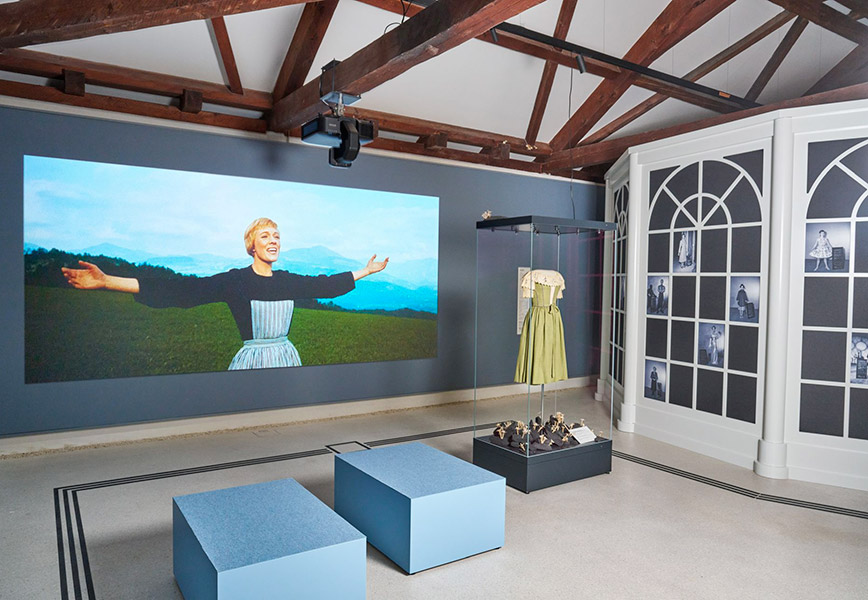
The former menagerie keeper’s house is used for reception and ticketing services, and houses the museum shop. In the castle’s carriage house, there is an exhibition dedicated to the film, the story of its success, and how it put Salzburg on the world map. There is notably a reconstruction of the pavilion – the real space being closed to the public for the sake of preservation – inside which a 3D projection plays the “Sixteen Going on Seventeen” scene in a loop.
Part of the exhibition is also devoted to the musical by Richard Rodgers and Oscar Hammerstein (1959), who first adapted the memoirs of Maria Augusta von Trapp. Upstairs, in the gamekeeper’s house (Jägerhaus), a historical exhibition looks at the history of the real von Trapp family, through intimate objects, such as the last Dirndl (traditional female costume) worn by Maria, or the navy costume of Georg, her husband. Their escape to the United States is also documented.
The common thread of this new museum is a reconciliation between historical and fictional stories, with overtones of reparation. At the time, the wounds were still too fresh in Austrian society to be able to accommodate the film, which was withdrawn from theaters two weeks after its release, due to an insufficient number of spectators. Beyond the discomfort caused, the annoyance came from inconsistencies or exaggerations in the scenario. Bringing together family and film archives in the same institution allows visitors, fans or not, to reread the phenomenon with an enlightened eye.
The plot of the film is built around the character of Maria, played by Julie Andrews, a young woman about to join a Benedictine abbey in Salzburg. She is sent to a family of seven children and their father Georg (Christopher Plummer), a widowed captain, to be their governess. She teaches the children to sing, and ends up abandoning her initial plan to take the orders to give a chance to the love she shares with the captain. Refusing to join the navy of the Third Reich, Georg prepares his escape with his family, the same evening when they give a concert together. The last scene shows them crossing the border on foot (but in reality they reached Italy by train). A worldwide success for both the public and the Academy, the film was awarded five Oscars in 1966.
Until November 1, the museum is open every day. During the month of October, it will be open from 9:30 a.m. to 5:30 p.m. It will only reopen from April 2027, and will gradually extend its hours until 7 p.m. in July and August.