Paris. When in 1869 Gabriele von Uckermann discovered with a friend the painting entitled La Mal’aria by Ernest Hébert during the International Exhibition of Fine Arts in Munich, the two young women sent a telegram to the artist to express their admiration. A few months later, the painter agreed to receive Gabriele in his Parisian studio and their marriage, in 1880, sealed their love at first sight. He is 63 years old, she is 28 years old. Five years later, the renewal of Ernest Hébert as director of the French Academy in Rome allowed the young woman to benefit from her own workshop. Gabrielle Hébert, who Frenchified her first name, made her photographic debut on July 8, 1888. From that day on, she never stopped photographing her husband. She will also endeavor to visually chronicle their stay at the Villa Medici as well as their travels in Italy, Sicily and Spain.
Then Gabrielle Hébert stopped photography when her husband died in 1908. It was only during the renovation of the Hébert Museum in La Tronche (Isère) that they were discovered in the attic. From 2006, Laurence Huault-Nesme, the director at the time, took care of restoring this fund. and presents at the museum three successive exhibitions of the amateur photographer but accomplished technician, with a keen eye.
Documented production
The retrospective signed by curator Marie Robert at the Musée d’Orsay is based on research carried out in the photo collections held by Orsay and that of the Musée Hébert, enriched by a careful study of Gabrielle Hébert’s correspondence and the diary in which she recorded the events of the day. The subtitle of the exhibition, “Mad Love at the Villa Medici”, although catchy, is somewhat misleading since the part strictly devoted to photographs linked to his stay at the French Academy in Rome represents only a third of the exhibition. But each period of this prolix production is contextualized using a variety of documents: diary, correspondence, camera, albums, contact sheets, etc.
Gabrielle Hébert (1853-1934), Amalia Scossa and Ernest Hébert at his painting The Virgin and the Goldfinch on the terrace of the campanilecirca 1891, gelatin aristotype, 9 x 12 cm, Paris, Musée national Ernest Hébert.
© Musée d’Orsay / GrandPalaisRmn / Alexis Brandt
If the small period prints require sustained attention from the viewer, the developed labels, the display cases rich in varied documents and the wall papers made up of negatives not necessarily printed, contribute to creating a portrait of a woman with a singular photographic itinerary.
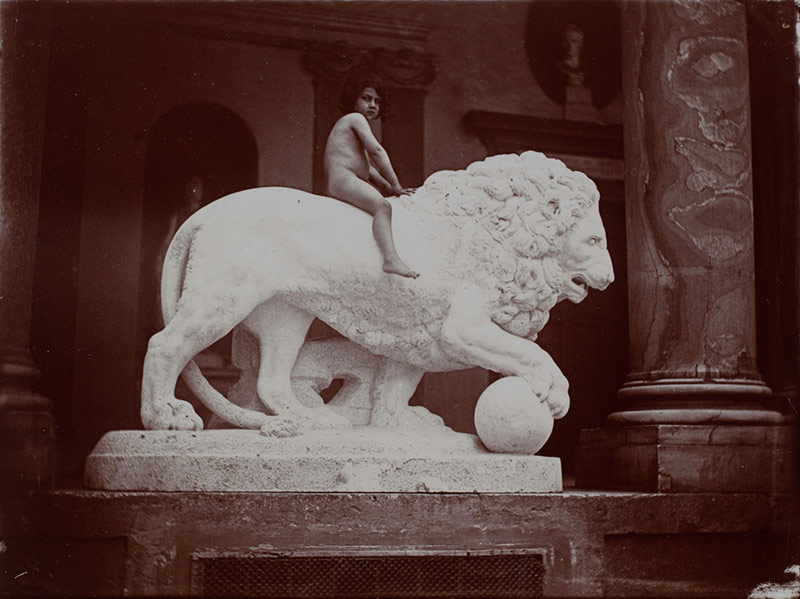
Photographs of sites, of Rome or of works of art held by Ernest Hébert, a great collector of souvenir photos used for his artistic practice well before his meeting with his future wife; friendship (love?) of Gabrielle with the young painter and resident of the Villa Alexis Axilette; influence of the Primoli brothers and the Pre-Raphaelites…: the exhibition shows the construction of his vision and its progressive broadening. Gabrielle Hébert sketches the artistic, intellectual and social life of the Villa Medici but also the staff who work for their comfort. Portraits, nudes, living paintings…, humans, whatever their social condition, are at the center of his images, here as in the couple’s travels. Images both influenced by the Pre-Raphaelite and Pictorialist artistic movements as well as taking advantage of the latest shooting and printing techniques.
“Gabrielle Hébert only works for herself. She does not have the ambition to be a recognized photographer,” underlines Marie Robert. Nearly a century and a half later, the modernity of her outlook eclipses the work of her husband.