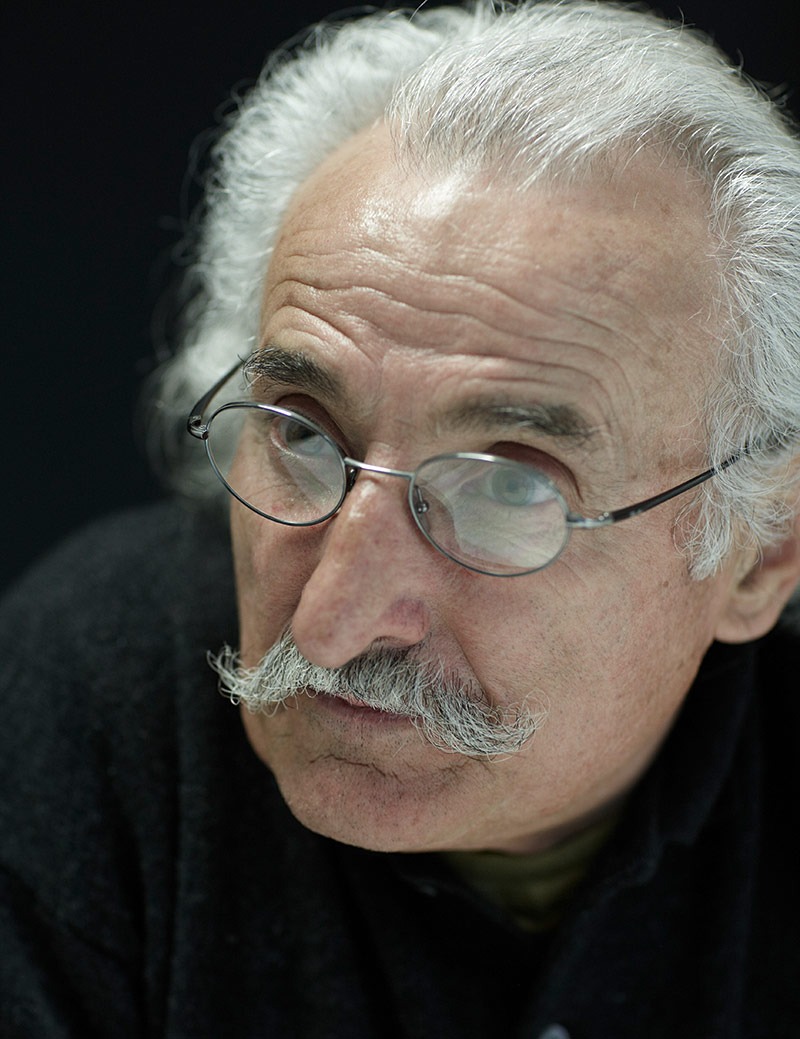
Throughout his life, Bernard Pagès maintained a mixed relationship with the Parisian art world. He has just passed away at the age of 86. Born in 1940 in Cahors (Lot), the trajectory of the sculptor, who has established himself as a major figure in contemporary art, is marked by an incessant movement back to nature, far from galleries and museums. An ambivalence that we find in the Support/Surfaces group in which he participated in the emergence, born in the south of France and propelled to the Museum of Modern Art in Paris in 1970, before disappearing three years after his birth.
But Bernard Pagès refuses to participate in the exhibition which made known the movement whose principles he helped define. Distrust of large institutions or desire for independence? Whatever his reasons, the artist left the group the following year, a year before its dissolution. There followed a period of distance from the artistic field, in the hinterland of Nice where he had settled in 1964.
Fertile withdrawal, because Bernard Pagès is far from interrupting his practice: during the 1970s, he composed the Assemblages and the Arrangements, inspired by rural life and craftsmanship, in which natural and industrial materials are brought into relationship. Wood, iron, brick and plaster give rise to original sculptures, sometimes emphasizing the elements, sometimes on the way of connecting them together. These series lay the foundations for his most iconic works, such as the Columns or the Stakes.
Art in chapels: view of Bernard Pagès’ installation in 2017
In 1974, Bernard Pagès reopened the doors of the museums. That year, he participated in an exhibition at the Museum of Art and Industry of Saint-Étienne. During the following decades, many institutions reserved personal exhibitions for him, including the Center Pompidou in 1982-1983, but also the Henri-Martin Museum in Cahors and the Matisse Museum in Nice, in 1995. In 2006, the Mamac in Nice paid tribute to him with a monograph and in 2015, his works on paper were exhibited for the first time at the Picasso Museum in Antibes, completing the knowledge of his work as a sculptor.
The Ceysson & Bénétière gallery, which represents Bernard Pagès, paid tribute to him, saluting “one of the great figures of international contemporary art” And “an exceptional man of rare kindness, attentive to everyone”addressing his thoughts to his loved ones and his wife, the author Maryline Desbiolles.