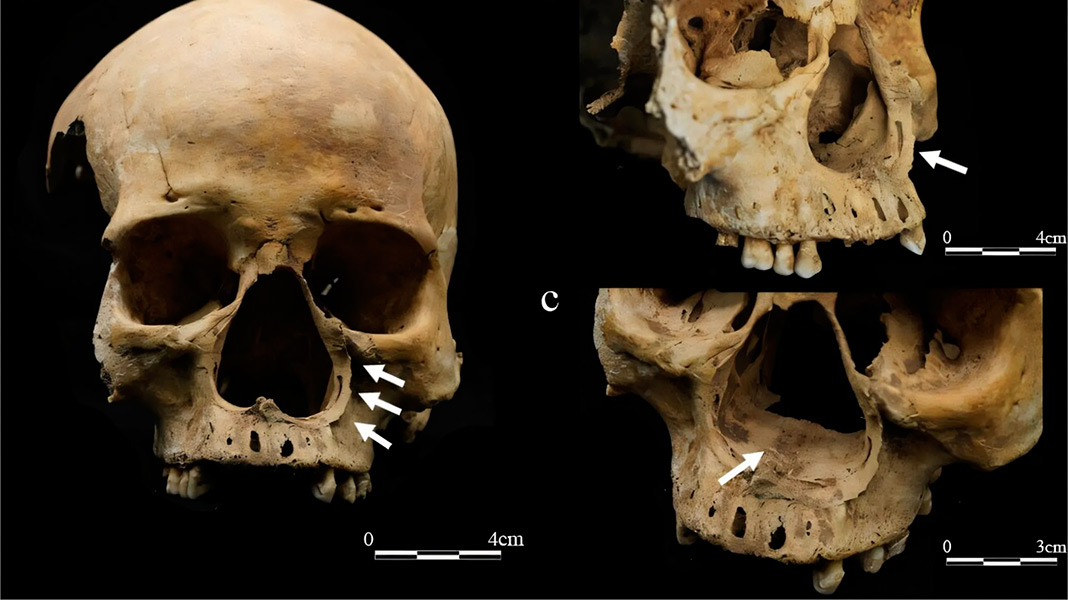
Its simple description makes one shudder. Listed in the archives, the removal of the nose was a punishment applied since Antiquity by the authorities in China. A team of Chinese and American researchers has just published the results of the analysis of a mutilated skeleton of a woman, dated between 1298 and 1404 discovered in 2019 in the Sanzhiyuan cemetery.
According to the authors of the study, this could be the first known archaeological testimony of nose amputation carried out as a criminal sanction in ancient China, a punishment until now documented by written sources. Professor at the Dental University of Texas and one of the authors of the study, Qian Wang pointed out that such a discovery could have been made previously, raising the possibility that traces of nasal amputation could have been overlooked in the past, or hidden by the state of conservation of the skulls, which were often fragmentary.
Noticing an abnormal gap at the level of the skeleton’s nose, the project’s archaeologists Global History of Health Project Asia Module were interested in this area and observed elements supporting the hypothesis of a mutilation. Examination of the skull revealed signs of scarring, indicating that the woman had survived her mutilation for several years. Bony growths around the nasal opening could also result from wearing a prosthesis, although researchers cannot confirm this hypothesis. The researchers’ observations also allowed them to rule out the hypothesis of a disease, such as leprosy, as well as that of blunt trauma.
Certain elements of a contextual nature also supported this hypothesis: the skeleton was the only one in the excavated area to have been buried face down. Archaeologists have interpreted this detail as a sign of social ostracization, aimed at marking the separation between this person and the rest of society, even in death.
The dating of the bones, between 1298 and 1404, does not allow them to be linked to a specific dynasty: the deceased could have lived in the Yuan (1271-1368) or Ming (1368-1644) era. In both cases, this archaic punishment had, in principle, already been abolished. The Yuan Shi, a 210-volume work on the history of the Mongol Yuan dynasty, includes a chapter on criminal law which confirms an evolution of punitive practices. It is explicitly written there that the ancient corporal punishments have been replaced, and the removal of the nose does not appear in the new measures in force. A 1336 decree promulgated under the Yuan, however, reintroduced the practice to punish certain offenses, stipulating that “he who steals an ox or a horse has his nose cut off”. Under the Ming, however, this practice was officially abolished.
Nose amputation is one of the five traditional Chinese corporal punishments, the origin of which is attributed by ancient texts to the Xia dynasty. According to the Book of Documents, this penal system provided for five categories of sanctions, ranging from facial tattooing to capital punishment, including amputation of the nose, mutilation of the foot and castration. The text distinguishes 3,000 categories of offenses: 1,000 types of offense were punishable by facial tattooing, as many by amputation of the nose, 500 by mutilation of the foot, 300 by castration and 200 by capital punishment. This system has undergone numerous transformations throughout Chinese history, notably during the Han, Yuan and Ming dynasties.