Madrid,
He trained as an architect, but in the seventies and eighties Alfonso Albacete became one of the greatest representatives of the innovations introduced in the practice of Spanish painting, in a path more or less similar to that followed by Pérez Villalta, also of his generation.
One of his emblematic pieces among the earliest is in the studio (1979), today in the collections of the Juan March Foundation, in which he combined figuration and abstraction by addressing a single motif, that of his workshop, which, in turn, absorbed three other genres of painting: the figure, still life and interiors. Since then and until now, this author from Antequera has deployed and deepened that experience, inventing different ways of the concrete act of painting as a propitiatory exercise of ideas.
His first exhibition at the Fernández-Braso Gallery in Madrid has just opened its doors, under the title “Field Painting”, and consists of thirty very recent works, dated in the last two years, in which the artist has summoned, around the patio of a farmhouse linked to his biography and his memories, some of his past and recent references, from Fra Angelico and Brueghel to Pollock and De Kooning, passing through Sorolla, Miró or José Guerrero.
Sometimes the allusions to these figures are very obvious and other times not so much, and they will be bathed in a clear, Levantine lighting or much more subdued in relation to the chiaroscuros of the Andalusian baroque that you know well. These different lights are projected on recurring motifs in his career that he rethinks by combining times: spaces that make up installations or games of mirrors, doors and windows, the studio as a place where everything can be born and time passes impassively.
This exhibition is part Gate to the riverthe first composition in which Albacete has decided to include the reproduction of the work of another author, De Kooning and his piece of the same title, in such a natural and organic way that it barely functions as a quote: the artist speaks more of a family portrait. Similarly, in Given takes to its field the tones offered by the peephole of Étant Donnés by Duchamp.
The series Andalusian baroquemeanwhile, was born thinking of Nacho Criado, who like him created so much from the observation of baroque painting, its trompe l’oeil and glazes. The passage through this region is sometimes more obvious to us and sometimes less so, and the very title of Settings In the compositions it responds to the one used by that one. This set was already presented at the last edition of ARCOmadrid.
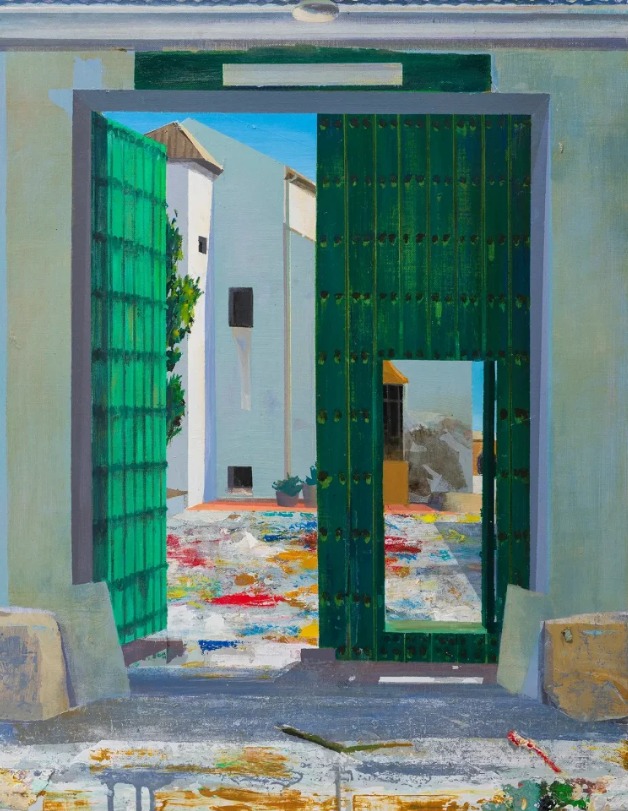
One of the pieces in the exhibition where Albacete’s architectural training is most evident is Placethat farmhouse patio that we started talking about, between whose doors anything can happen in the painting of the man from Malaga. Although he came to this theme, that of the puetas, at first because of its symbolic nature (with baroque echoes), it gradually served him to add his references to his production, as we saw in Gate to the river; in that line, in Barpresents us with a crossbar raised with drippings in which the abstraction begins where the floor begins. Wherever one paints, Albacete seems to mean, everything is an adventure: the pigment drips, is stepped on and spreads beyond the previous idea (always present).
More than once (Apeos) that chance is opposed to the order of what is built by human hands, evoking the theory of fractals – the geometry that is repeated in nature – but also, and above all, the linear base of the creations with flags or numbers by Jasper Johns and the drawings of Mexican or Indian capitals by Frank Stella.
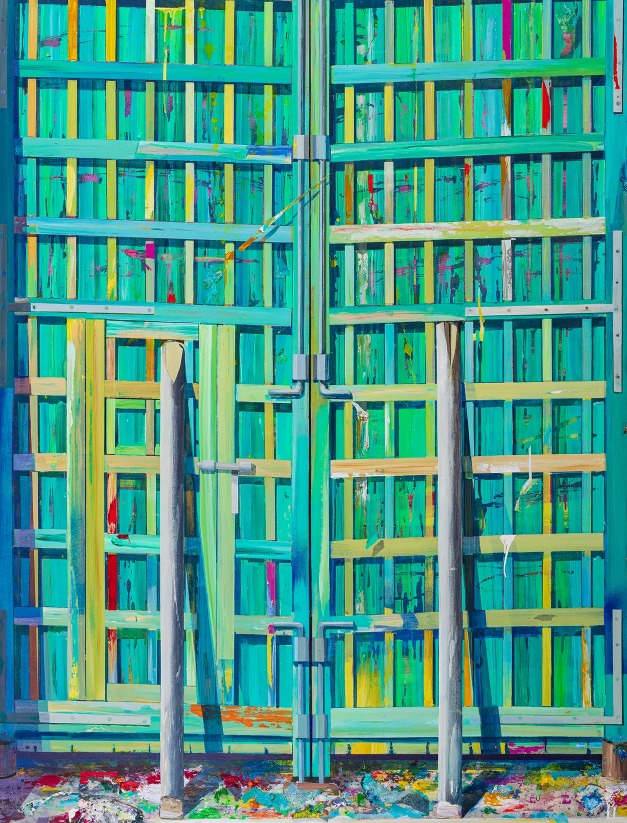
For Albacete, painting is not only a means of expressing specific issues or concerns about how to represent them, but also a source of “ingredients for thought.” That is why some cover various times and lights and incorporate mythology, such as the complex Iphitus-Four water paintingswith numerous different planes and even a representation of the golden section as a shell nautiluswhich could in turn correspond to the back of the viewer’s neck. “The painting goes beyond the idea that forged it.”
In two stages, on a previous fabric, it is made Judith/Salomewith a table-still life with the severed head of the Baptist, a travel painting and a dance in which the seven veils are identified with the primary and secondary colors and black: we witness the outcome of events in the form of a battle of lights.
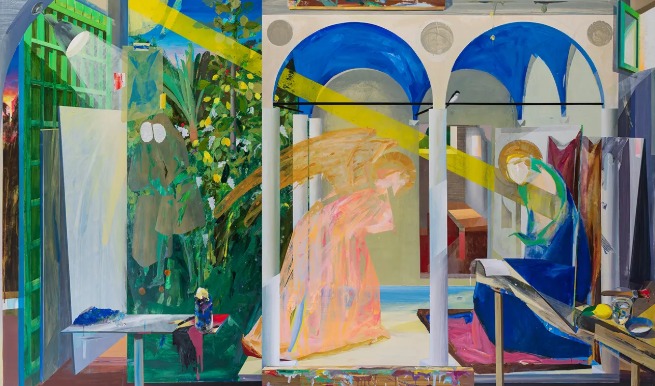
and your Annunciation It is also a painting within another painting; Albacete approached Fra Angelico’s masterpiece attracted by the contrast between nature and architecture, the measurable and the uncontrolled. A swallow, apparently a mere spectator, structures the entire choreography, and the white faces of Adam and Eve embody all the faces and none.
Alfonso Albacete. “Field painting”
FERNÁNDEZ-BRASO GALLERY
C/ Villanueva, 30
Madrid
From April 16 to June 13, 2026