Paris. Robert Capa is regularly the subject of exhibitions, books and studies. It is true that the life and work of the illustrious war photographer, born in Budapest in 1913, under the name Endre Friedmann, still reveal little-known aspects and photographs. For her first exhibition dedicated to the war photographer that he was, the director of the Musée de la Libération de Paris – Musée du Général-Leclerc – Musée Jean-Moulin, Sylvie Zaidman, started with the traveling retrospective “Robert Capa” proposed by the Magnum agency based on its archives and the collection of the Golda Darty group, an investment company headed by Steven Darty and Jean Sarkozy (son of Nicolas Sarkozy and son-in-law of Steven Darty). Last year, “Icons. Robert Capa”, at the Franciscaines in Deauville, revealed his collection of prints, publications and objects.
Robert Capa (1913-1954), Resistance members crouching behind a Willys jeep during the Liberation, Paris, August 25, 1944.
© Robert Capa / International Center of Photography / Magnum Photo
In Paris, Sylvie Zaidman, curator of the exhibition, enriches it by going further in the subject and expanding it to other public or private collections, in particular that of the journalist and collector of photographs, Michel Lefebvre, co-curator of the exhibition. It is in fact a matter of explaining the profession of war photographer that Capa revolutionized, its conditions and the role played, in his career, by his early involvement in anti-fascist movements.
An educational visit
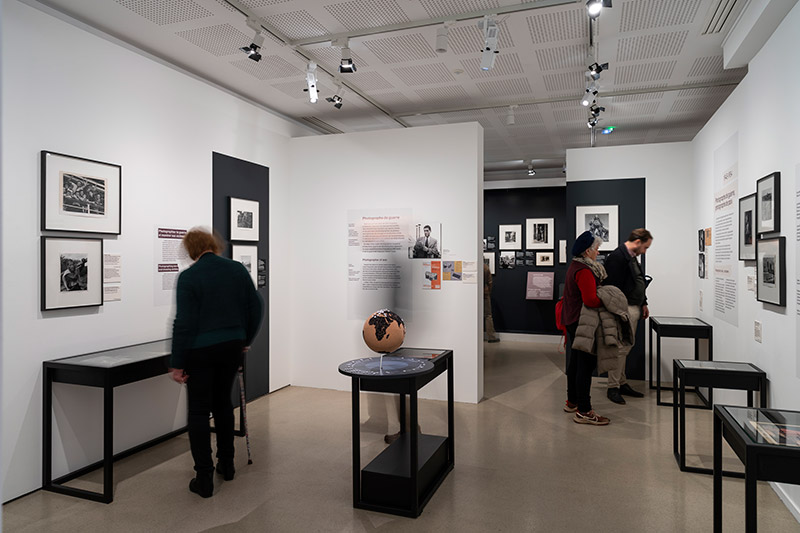
The chronological journey is intended to be educational, particularly for young people unfamiliar with film photography and what it involves in terms of photo equipment, circuitry and development time. There are numerous texts in different formats and lengths both on the walls and in the windows, and their location does not interfere in any way. The mention of the cameras used by Capa in each text introducing a new chapter, as well as the indications on the publications of his images in magazines or contact sheets, make it possible to understand the material, technical and media conditions of his emergence while giving flesh to the personality and to the photo-reporter at the heart of the events that he was, always as close as possible to those who fought.
The museum’s editing of filmed archives of the Liberation of Paris, August 25 and 26, 1944, constitutes the nodal point of the exhibition. Signed by Vincent Bray, audiovisual manager of the museum, the film, a real scoop, shows his way of being in action and retraces his journey and the photographs taken those days. It took more than a year of work to identify him among the soldiers or in the crowd.
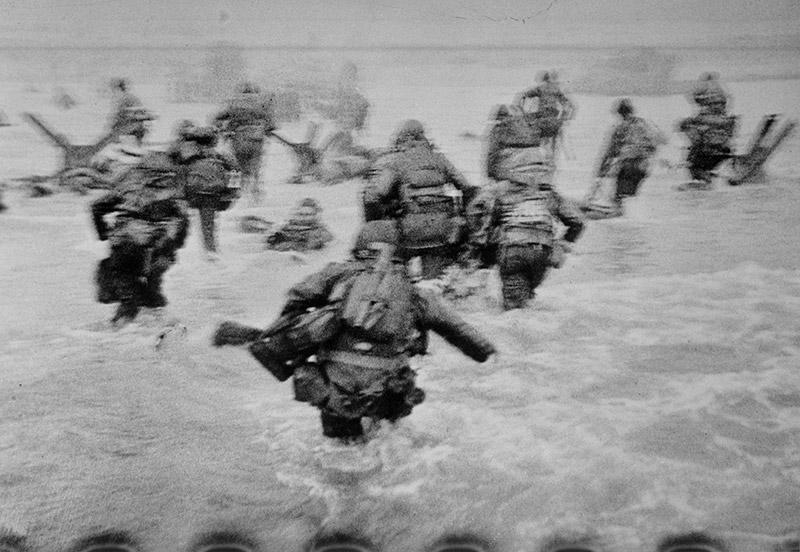
Robert Capa (1913-1954), American troops storm Omaha Beach during the Landings, Normandy, June 6, 1944.
© Robert Capa / International Center of Photography / Magnum Photo