Madrid,
Imagine that you dance in a full hall of your person, person, and do not regard yourself. Faites tous les mouvements du monde, car personne ne vous voit.
Concert by concert, Zaho de Sagazan begins his last song by asking the audience to move as if no one was watching, forgetting the gaze of others so that his dance is free and liberating. It is not a new procedure (the Greeks already considered this discipline as a vehicle for connection with the gods and for purification), but rather a timeless rite that transcends cultures and, more recently, subcultures.
These effects largely support Siratthe latest film by Oliver Laxe, which has just become a candidate for the Oscars in five categories, and also the installation that this filmmaker is now presenting in Space 1 of the Reina Sofía Museum, which premieres programming dedicated to creators who experiment with exhibition cinema and who investigate, in an open and non-conclusive way, how art and the big screen have mutually nourished each other.
Laxe trained in Advertising and Public Relations, but as a student he began to make his first installations, and today he has expressed his close relationship with the arts from the beginning: his desire to work from space, to transfer this to the image and to offer sensations to the body has a lot to do with the plastic.
HU/هُوَ. Dance like nobody’s watchingwhich is the name of the piece offered at the MNCARS, under the curatorship of Chema González and Julia Morandeira, is a work with its own autonomy, but completely linked to Sirat, in which Laxe resorts to a radical treatment of the viewer’s environment, to the forceful but sober gesture and to the incorporation of darkness to favor the suggestion of mystery and awe. Ultimately, it proposes an exercise in synesthesia: sound, space and image converge to provoke an experience, far from literal forms, that is expected to be complex and individual.
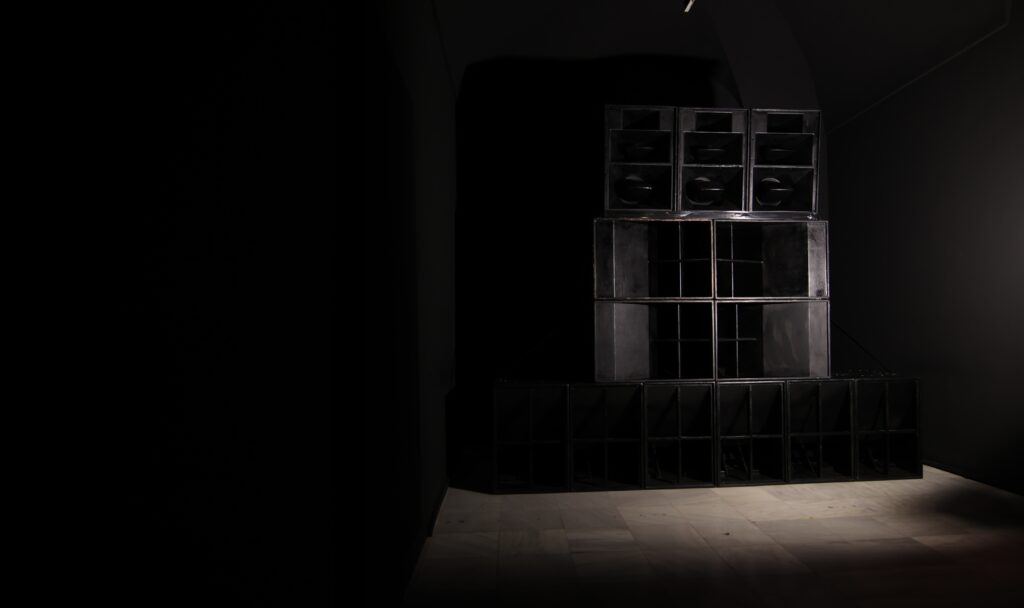
The videographic work is preceded, in a dark room, by a pyramid of speakers that refers to the world of raves in which Luis (Sergio López) immerses himself, in Sirat, to search for his missing daughter. In that darkness, this pyramid takes on the role of a totem and emits a constant and uniform vibration that can already be sensed in the cloister of the Reina Sofía; This previous stay here takes on the role of preparing the visitor’s senses for the installation itself.
In HU/هُوَ Finally, we attend the triple loop projection, for about a quarter of an hour, of a part of the dance of three of the injured individuals who expose their lives in Sirat and they find a mix of peace and cathartic torture dancing in the desert, as well as images that Laxe filmed a decade ago in Iran, in ancient religious architecture; Its geometry and proportions are linked to the sacred, in the same way that free movement in the sublime setting of the most barren areas of Morocco implies in the film, and for its characters, a transcendental dimension that arises in the gray areas between celebration and bitterness. In the museum, by the way, Kangding Ray (David Letellier), sound engineer in the film, has once again been in charge of the sound, giving it body.

The installation does not have a narrative character (so viewers can join in at any time during the screening), and it also lacks explicit symbols that point to closed readings of any kind: a believer in ambiguity, this filmmaker born in Paris and of Galician origins has chosen to use sensory abstraction. It is his way of not intellectualizing this project too much – as he has stated, so that it is not born dead and to give space to the unconscious. The work, he has pointed out, starts today.
It will precede others in which – he points out – he will continue to take risks (The public wants the artist to die before he dies) and will try to maintain his artistic gesture without deceiving himself. Knowing that there is nothing worse for a director than not being understood, but also that generating discomfort is a sign that the film has germinated emotions, it has worked.
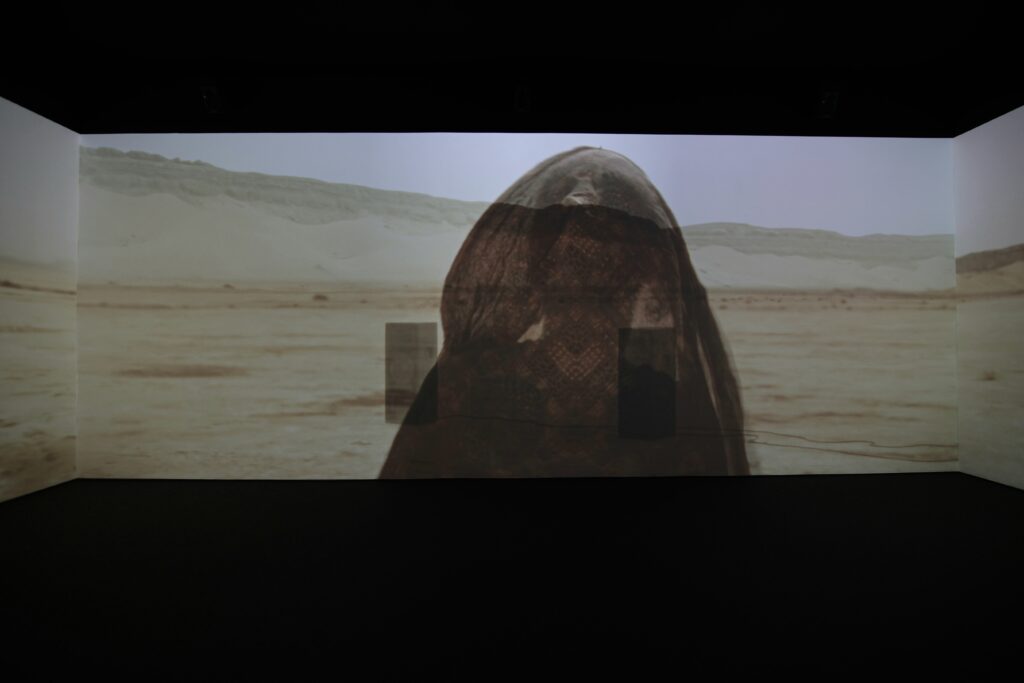
Oliver Laxe. “HU هُوَ. Dance as if no one is watching.”
NATIONAL MUSEUM REINA SOFÍA ART CENTER. MNCARS
C/ Santa Isabel, 52
Madrid
From December 17, 2025 to April 20, 2026